
Michigan Corrections Release Scope
The Michigan Department of Corrections is a statewide prison and community-supervision system. It does not operate the Antrim County Correctional Facility. MDOC receives people committed to state prison, supervises parolees, and supervises many felony probationers. No MDOC prison was identified as physically located in Antrim County.
OTIS, the Offender Tracking Information System, covers prisoners, parolees, probationers, and people discharged within three years. It excludes county-jail and city-lockup populations as well as jail-only sentences. A person who bonded out of the Antrim jail may never appear. A person transferred from Antrim to state prison should be followed in OTIS because the county departure was a custody transfer.
| OTIS status | Meaning for release |
|---|---|
| Prisoner | Still in MDOC prison custody |
| Parolee | Physically out of prison but under MDOC supervision |
| Probationer | Under a court-ordered supervision term that may not follow prison |
| Discharged | MDOC jurisdiction has ended |
| Parole or probation absconder | Supervision continues despite alleged loss of contact |
Note: OTIS status proves an MDOC relationship; it does not import or explain an Antrim jail-only booking.
Search Michigan Corrections Releases
The live OTIS search accepts an offender number or at least a last name. An MDOC number is the strongest starting point. When only a surname is known, OTIS permits a wildcard after at least three leading characters. Use other fields to narrow a result, not to force a weak match.
- Enter the MDOC Offender Number when known. Otherwise enter the commitment last name and optional first name.
- Choose Parolees to look for physical prison release with continuing supervision.
- Run a second search under Discharged to check for completed MDOC jurisdiction. Use All when status is uncertain.
- Open the profile and verify MDOC number, age or DOB, county, court file, offense, and sentence.
- Read Current Status. For parole, also read Date Paroled, Assigned Location, Supervision Begin Date, and Supervision Discharge Date.
- Keep the search date and URL. OTIS public retention is limited and individual fields can change.
The official OTIS interface shows the status filters and identity fields used in this process:
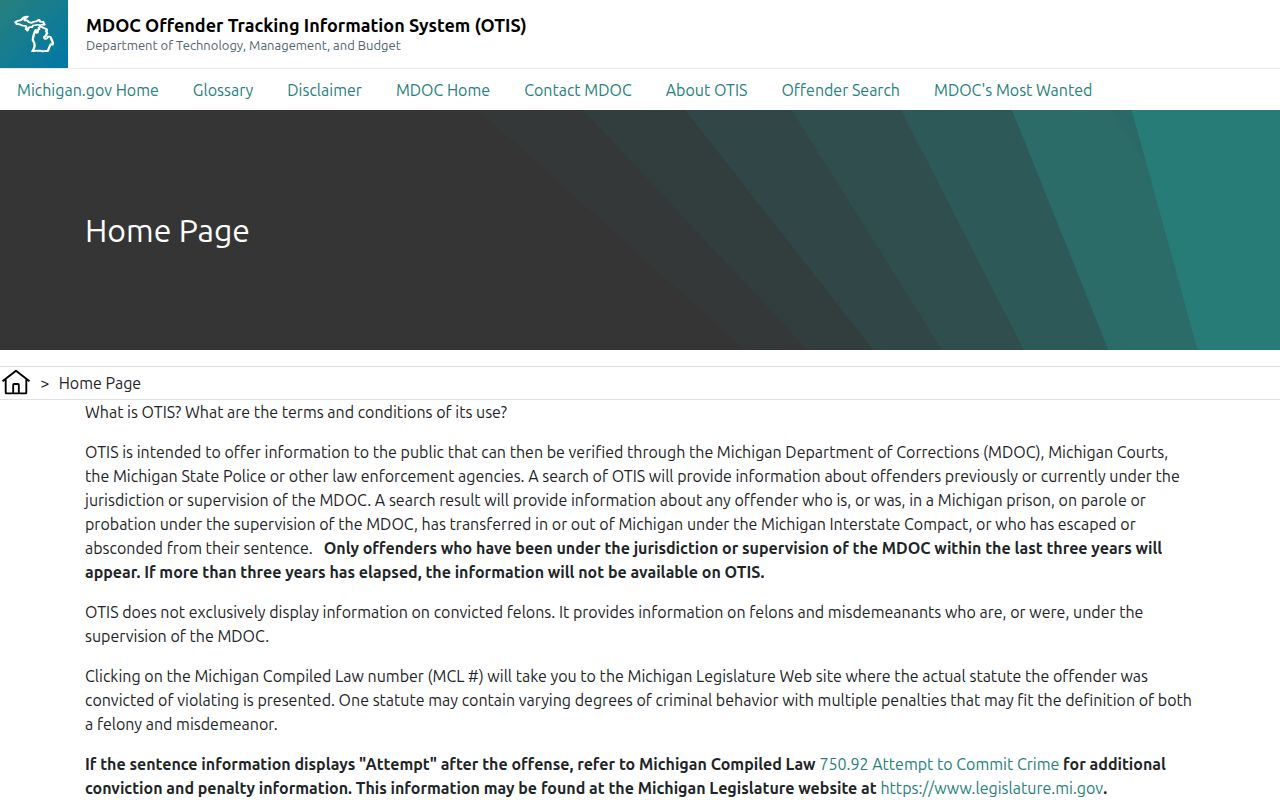
The captured state page confirms that parolee and discharged searches are separate. Running both prevents physical release from being confused with the later end of supervision.
Michigan Corrections Release Fields
An OTIS profile may include an offender photo and image date, MDOC number, SID, commitment name, aliases, physical details, current status, assigned location, and supervision dates. Sentence blocks can show the offense, minimum and maximum sentence, statute, court file, offense date, county, sentence date, and whether a sentence is active. Not every profile has every field.
| Profile field | How to read it |
|---|---|
| Current Status | The present MDOC category, such as Prisoner, Parolee, or Discharged |
| Date Paroled | A retrospective date showing prison departure or acquisition of parole status |
| Assigned Location | The prison or supervision office connected to the current status |
| Supervision Begin Date | The start of the community-supervision period |
| Supervision Discharge Date | A planned or completed date that must be read with Current Status |
| Parole Board Jurisdiction Date | The earliest date the Board may gain jurisdiction, not a release appointment |
| Maximum Date | A sentence boundary, not a promised exit time |
A future supervision discharge date is not proof that supervision has ended. “Discharged” is the clearer public status for completed jurisdiction. Likewise, a photo is a state correctional image and not necessarily the Antrim booking photograph. Image absence does not change release status.
Michigan Corrections Release Date Terms
Michigan uses indeterminate sentences for many prison cases, with a judicial minimum and maximum. OTIS uses `PAROLE BOARD JURISDICTION DATE`, also described by MDOC as the earliest release date or ERD. It marks when the Parole Board may gain jurisdiction. It does not schedule a prison departure.
The official OTIS field definitions explain release and status terminology:
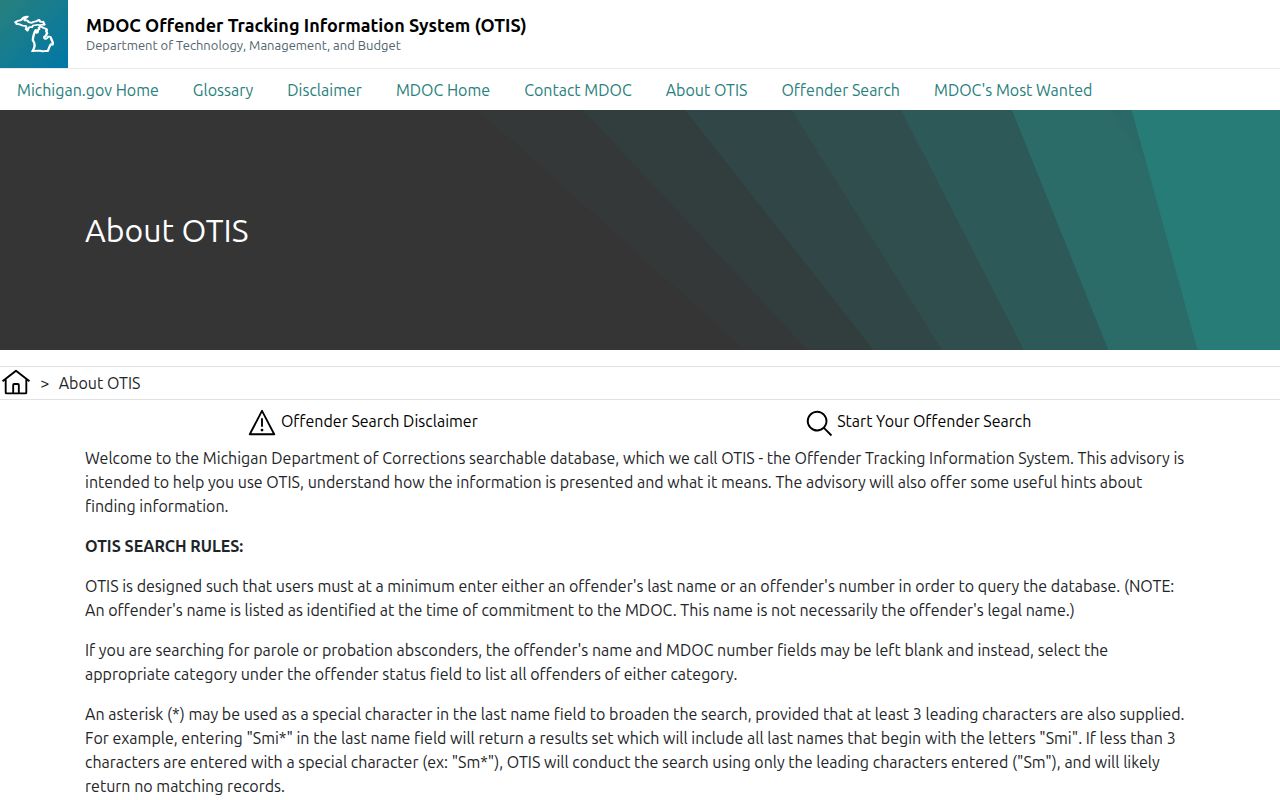
The source supports a key hierarchy: Date Paroled is retrospective, while ERD and a future supervision date are prospective. A Board grant can also be suspended before release, so the later Parolee status and Date Paroled should confirm the actual event.
Michigan Truth in Sentencing is not an 85% rule. MDOC states that covered prisoners serve 100% of the judicial minimum before parole consideration. Listed assaultive offenses committed on or after December 15, 1998, and other covered offenses committed on or after December 15, 2000, do not use good time or disciplinary credits to shorten that minimum. Legacy cases can follow different credit rules based on offense date and law.
Note: A future OTIS date should be reported as prospective until a later status or source records the event as complete.
Michigan Corrections Parole Decisions
The Michigan Parole Board is the sole paroling authority for felony offenders committed to MDOC. MCL 791.234 establishes jurisdiction, while MCL 791.233 makes eligibility distinct from a grant. Routine parole consideration commonly begins about six months before eligibility or reconsideration, and an interview is generally conducted by secure video.
A grant moves to the Parole Release Unit for date, placement, term, and condition planning. MDOC requires at least 28 days between a Board release decision and physical release. Adverse information or misconduct can suspend a grant. Denial, deferral, grant, and revocation are different outcomes, and none should be converted into a release date without the individual record.
Michigan does not publish a verified public calendar of routine parole interviews or a person-level statewide decisions database. The public-hearing list is narrower, covering clemency matters and certain lifer-law proceedings. Aggregate quarterly reports do not confirm a named person’s outcome. Use OTIS, formal notice, Board contact, or a focused records request.
After release, Assigned Location can lead to the MDOC field-office directory. Antrim County’s local supervision questions can be routed through the Post-Release Supervision page after OTIS confirms the status.
Michigan Corrections Release Records
OTIS is a public status source, not the complete correctional file. A targeted MDOC FOIA request may seek a Basic Information Sheet, discharge certificate or order, parole order, date and reason for discharge, sentence-computation or time-review record, and an offender photo if available. Identify the person by MDOC number and request named existing records.
MDOC FOIA Coordinator
P.O. Box 30003
Lansing, MI 48909
Email: MDOC-FOIA@michigan.gov
Phone: 517-335-4194
Fax: 517-335-4193
MDOC’s FAQ describes a certified PENPACK with documents such as a Basic Information Sheet, Judgment of Sentence, photo, fingerprints, and Discharge Certificate. That package is limited to recognized criminal-justice authorities for official business. A public requester should not expect a PENPACK and should instead use the MDOC FOIA process, subject to exemptions and redaction.
Current-prisoner record questions may be sent to Corr_Records_Info@michigan.gov. MDOC directs past-prisoner requests within its stated up-to-six-year post-release window to MDOC-Records_Retention@michigan.gov. Older cases may require archives or another record route. State computer records reach only to about 1980.
Michigan FOIA asks for a sufficiently described existing record. It does not require MDOC to answer research questions or build a new compilation. Ask for reasonably segregable nonexempt portions if material is withheld.
Note: Public OTIS access and MDOC records retention are separate channels with different scope, duration, and request procedures.
Michigan Corrections Contact Points
The MDOC general office handles statewide department matters. It is not the Antrim jail records office. For a jail-only bond, dismissal, time-served release, or local booking sheet, contact the Antrim County Sheriff instead. Use MDOC contacts only when OTIS, a court commitment, or another official record establishes department jurisdiction.
Michigan Department of Corrections
Grandview Plaza
206 E. Michigan Ave.
P.O. Box 30003
Lansing, MI 48909
Phone: 517-335-1426
Monday through Friday, 8 a.m. to 5 p.m. Eastern
- Parole Board
- 517-373-0270 and Parole-Board-Staff@michigan.gov
- Field Operations Administration
- 517-335-1979 and mdoc-foa-admin-public@michigan.gov
- Absconder/Escapee Tip Line
- 517-755-0855; contact law enforcement rather than approaching a person
Errors in court-originated sentence, offense, or date data should go to the sentencing court. A wrong supervision or absconder status should go to the assigned parole or probation office. MDOC may correct its information when directed by a court order or supervising agent.
Michigan Corrections Record Retention
The official OTIS scope page states that discharged profiles remain public for three years after supervision discharge:
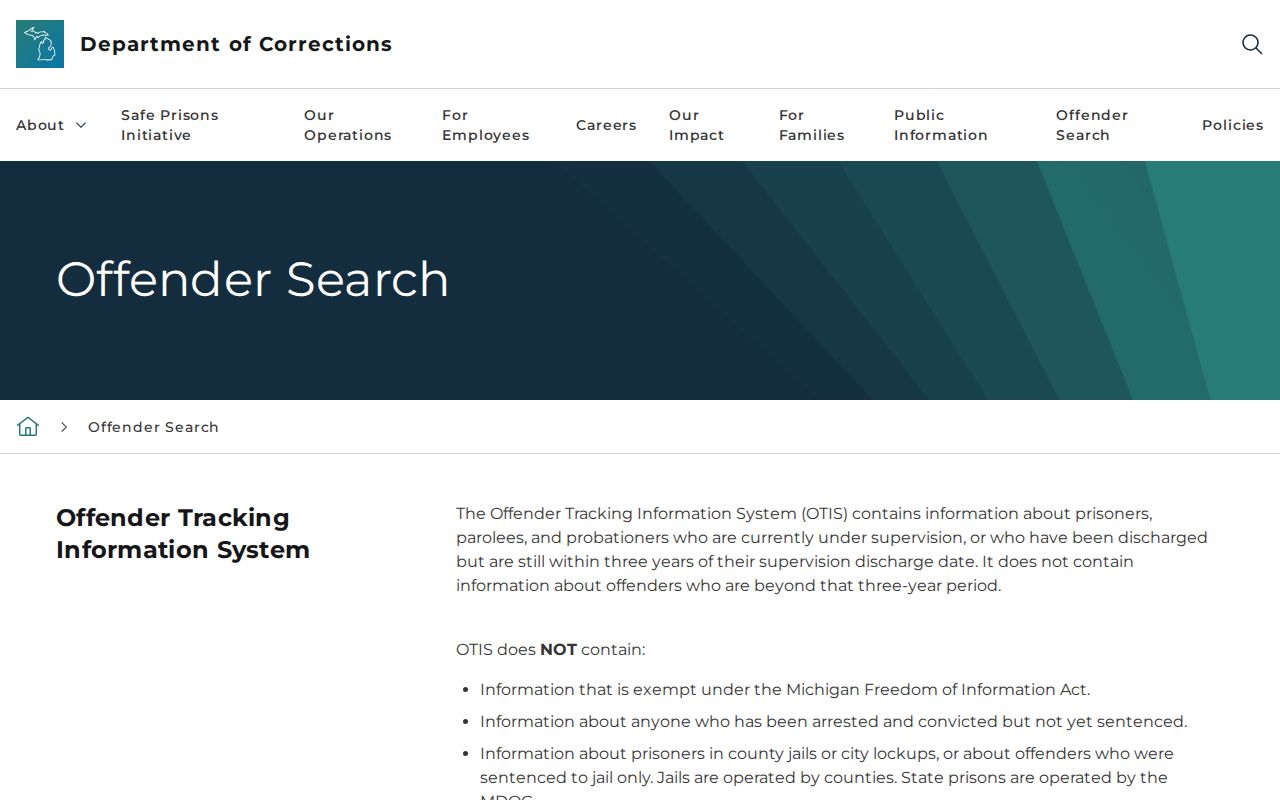
The state source shows why an old no-result is weak evidence. The person may have passed the public retention window, used a different commitment name, fallen outside MDOC scope, or had a conviction set aside. Search notes should record the name, identifier, status filter, time, and source URL.
A set-aside can remove OTIS information from public view. That change in access does not prove that custody or release never occurred. For a durable record, request the specific MDOC document while respecting any exemption or court restriction. A transient error should be classified as unavailable, not negative.
When the custody trail begins at the county jail, use the Antrim County released-inmate lookup to decide whether the person actually entered MDOC. The county release record can establish the transfer out, while OTIS establishes the later state status.