
Understand Antrim County Releases
A release from the Antrim County Correctional Facility means that one county booking ended. It does not always mean the person entered the community. Bond, a personal-recognizance order, dismissal, time served, probation, or completion of a jail term may lead to a community departure. A transport to another county, the Michigan Department of Corrections, the U.S. Marshals Service, or immigration custody is a transfer. The person has left Antrim custody, but another custodian may still hold them.
The best record depends on that next step. The sheriff’s booking and release record can show when county custody ended and the administrative disposition. A court file can show the order that authorized bond, dismissal, sentence credit, probation, or commitment. MI-VINE may report a participating agency’s custody change. OTIS applies only after MDOC jurisdiction begins. Keeping those records separate prevents a common error: treating absence from a local jail page as proof that all custody ended.
Confirmation is strongest when two records describe the same event. Match a booking or case number, not just a name, and note the date each source was checked. A positive sheriff timestamp plus the related court order can establish a county release. An Antrim transfer entry plus a new OTIS prisoner record can establish a move to MDOC instead. If systems update at different times, label the gap as unresolved. A temporary error, filtered court result, or missing MI-VINE match is not a negative finding. The office that owns the disputed field should resolve it: the sheriff for county release data, the court for its order, and MDOC for supervision status.
- Time served
- A sentence satisfied by time already spent in custody.
- Parole
- Physical release from prison while MDOC supervision continues.
- Probation
- Court-ordered community supervision that may occur without a prison term.
- Discharge
- Completion of MDOC jurisdiction, not merely departure from prison.
Trace Antrim County Release Types
The release code and receiving-agency field matter more than the fact that a name disappeared. Antrim County has not published a public code dictionary, so a requester should ask for the exact release or disposition code and its legend. The following routes describe the records to seek, not guaranteed labels in the jail system.
| Custody outcome | What it means | Best next record |
|---|---|---|
| Bond or recognizance | Community release while the case continues | Sheriff release record and court bond order |
| Dismissal or time served | The local custody basis ended, subject to other holds | Release timestamp and court disposition |
| Probation | A community sentence may follow the jail departure | Court judgment and, for felony supervision, OTIS |
| MDOC commitment | Transfer to state jurisdiction, not community release | OTIS prisoner record |
| Federal or ICE transfer | Another custodian receives the person | BOP, federal court, USMS contact, or ICE locator |
A court order and the physical exit can carry different times. Staff must receive the order, check holds, process property, and complete the jail’s release steps. For that reason, “ordered released” and “left the facility” should not be used as synonyms. The sheriff record is the stronger source for the local exit time.
Note: Ask for Antrim’s actual code legend because another county’s release labels may not match the local jail system.
Read Antrim County Release Records
A useful Antrim County release request starts with the person and booking, then asks for the full custody timeline. The county does not offer a public release-detail screen or a sample data dictionary. Asking for existing fields and any code legend avoids inviting staff to create a new explanation, which Michigan FOIA does not require.
| Requested field | What it can establish |
|---|---|
| Name and booking number | The identity and county custody event |
| Admission date and time | When the booking began |
| Release date and time | When that county booking ended |
| Release or disposition code | Bond, sentence completion, transfer, or another recorded outcome |
| Charges, case, and court | The judicial file tied to custody |
| Hold or receiving agency | Whether another custodian followed Antrim |
| Bond or authorization | The authority used for the release process |
Not every record contains every field. If a transfer occurred, the Antrim record proves only the county side of the handoff. A receiving record from MDOC, another jail, BOP, USMS, or ICE is needed to establish what happened next.
Antrim publishes no roster-retention or recent-release retention period. The absence of a public archive does not mean the underlying booking and release records vanished. It means the durable county document must be requested from the sheriff. Read that document as a timeline: admission, court authority, hold review, recorded disposition, receiving agency if any, and physical exit. If one event is missing, ask for the existing sheet or log that owns that point rather than assuming all events occurred together.
Note: A sheriff release timestamp and a receiving-agency status together document both sides of a custody transfer.
Request Antrim County Release Records
The Sheriff FOIA page is the direct local route. Records Clerk Natasha Cook is identified as coordinator. Requests may be delivered to 209 Portage Drive, Suite A, Bellaire, mailed to P.O. Box 568, Bellaire, MI 49615, or faxed to 231-533-5803. Procedural questions go to 231-533-8627. The countywide FOIA route, FOIArequest@antrimcountymi.gov, is useful for general help, but jail records should start with the sheriff.
- Give the person’s full name, date of birth if known, case or booking number, and a narrow date range.
- Ask for the booking sheet, admission and release timestamps, disposition code and legend, receiving agency, release authorization, and related hold information.
- Request electronic delivery or inspection and ask for a cost estimate before copies are made.
- Mark the subject or cover “FOIA Request,” then keep the sent copy and delivery date.
- Read the response precisely. A denial, no responsive record, another custodian, or a deposit request are different results.
Under MCL 15.235, the public body generally has five business days to grant, deny, partially grant, or issue one written extension. An electronic request is treated by the sheriff as received one business day after transmission. A deposit of half the estimated cost may be required when the estimate exceeds $50. A qualifying indigent requester may seek the first $20 waiver with the required affidavit. No fixed price for a release sheet is published.
Follow Antrim Release Court Records
Antrim’s criminal court trail can span two levels. The regional 86th District Court handles misdemeanors and early felony steps, while the 13th Circuit Court holds felony adjudication and sentencing. A bindover in district court is not the final felony result. Search the correct location in MiCOURT Case Search, then read the register of actions, bond changes, disposition, judgment, sentence, credit, probation, or commitment.
The 86th District Court warns that public criminal-data extraction is restricted while automatic set-aside records are reconciled. A missing online result can therefore reflect an access limit rather than no case or a release. The official file-review or copy channel may be needed. Court entries explain the legal basis, but they may not show when release processing finished at the jail.
Note: Record the court, name variant, case number, search date, and result so an unavailable search is not mistaken for a negative result.
Clean Slate and Antrim Releases
Michigan’s automatic Clean Slate process began in 2023 and can remove eligible convictions from ordinary public view. A court-ordered set-aside changes public access but does not rewrite the historic fact that a custody event once ended. MiCOURT filters, sealed matters, nonpublic case types, and reconciled automatic set-aside records can all affect what a public search returns.
OTIS access also has limits. MDOC generally displays a discharged person for three years after supervision discharge. It may remove a profile sooner when directed by court order or when legal criteria apply. Past-prisoner records may remain available through MDOC Records Retention for up to six years after release, while older material can require FOIA or the Archives of Michigan. A no-result should be classified as inconclusive until scope, date, spelling, and record-access changes have been checked.
Find Antrim County Released Inmates
Antrim County publishes neither a verified current roster nor a recent-release archive. The official inmate-information page points to services and VINELink, but it does not show a 24-hour or 72-hour list. A named-person search therefore starts by identifying the custody system, then follows records that cover that system.
- Search the Antrim court path for bond, dismissal, sentence, probation, or a commitment to another custodian.
- Check MI-VINE for a matching person and agency, while treating a missing result as inconclusive.
- Call the correctional facility at 231-533-8627 and ask whether the booking ended in community release or transfer.
- Request the booking and release sheet when durable proof or a precise timestamp is needed.
- If the court shows MDOC commitment, use OTIS. Use BOP, federal court or USMS, and ICE only when those systems are relevant.
Search MDOC Antrim Release Status
The MDOC Offender Tracking Information System, known as OTIS, applies to state prisoners, parolees, felony probationers, and people discharged within its public window. It does not import Antrim jail-only bookings. Search by offender number when possible. Otherwise, enter a last name, using a wildcard only after at least three leading surname characters, then verify the county, case, court file, age, and MDOC number.
| OTIS field or filter | How to use it |
|---|---|
| Last and first name | Begin a name search and narrow same-name results |
| Offender number | Best direct identifier when known |
| Parolees | Find physical prison release with supervision continuing |
| Probationers | Find MDOC-supervised felony probation |
| Discharged | Find completed MDOC jurisdiction within the public window |
| Date Paroled | Confirms the past physical prison-release event |
| Assigned Location | Points toward the responsible field office |
The official OTIS scope page explains that discharged records normally remain public for three years. A future Supervision Discharge Date is prospective, while Current Status: Discharged is the stronger sign that MDOC jurisdiction ended.
The live search layout can be reviewed in the official OTIS search.
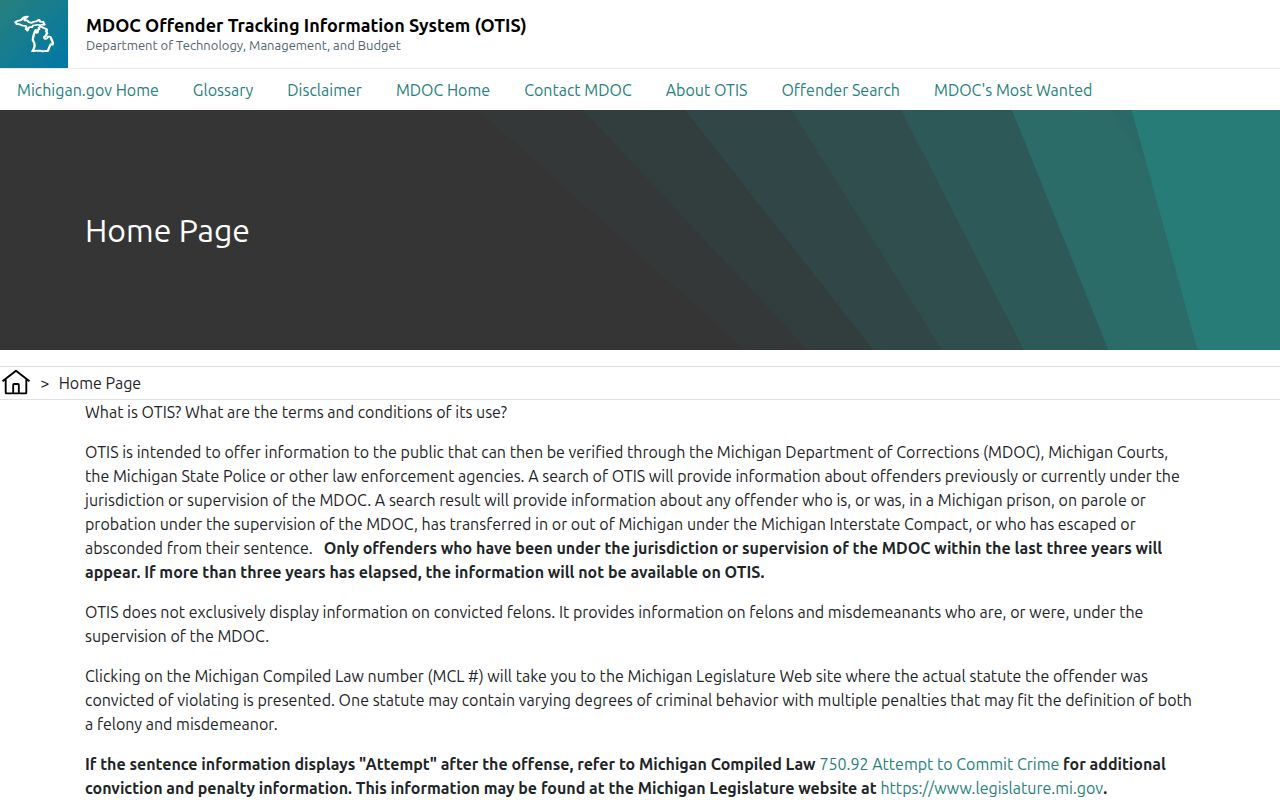
The displayed status filters help separate a prisoner, parolee, probationer, absconder, and discharged person before a profile is interpreted.
Note: Search both Parolees and Discharged because physical prison release and completed MDOC jurisdiction are separate statuses.
Antrim Jail History Shapes Releases
The Antrim County Correctional Facility dates to 1955, has been renovated, and is rated for 56 people. Corrections staff transport people to other jurisdictions and state prisons. That local operating role makes receiving-agency information essential. A person removed from the county facility may be en route to MDOC or another custodian rather than home.
Rated capacity is a facility fact, not evidence about current population, crowding, or the reason a named person moved. The useful release fact is the documented transport role. When the sheriff record lists a receiving agency, follow that agency’s record. When no destination is available by phone, request the release sheet and the receiving-agency field rather than inferring a community departure.
The official county facility page documents the jail’s history, size, and transfer role:
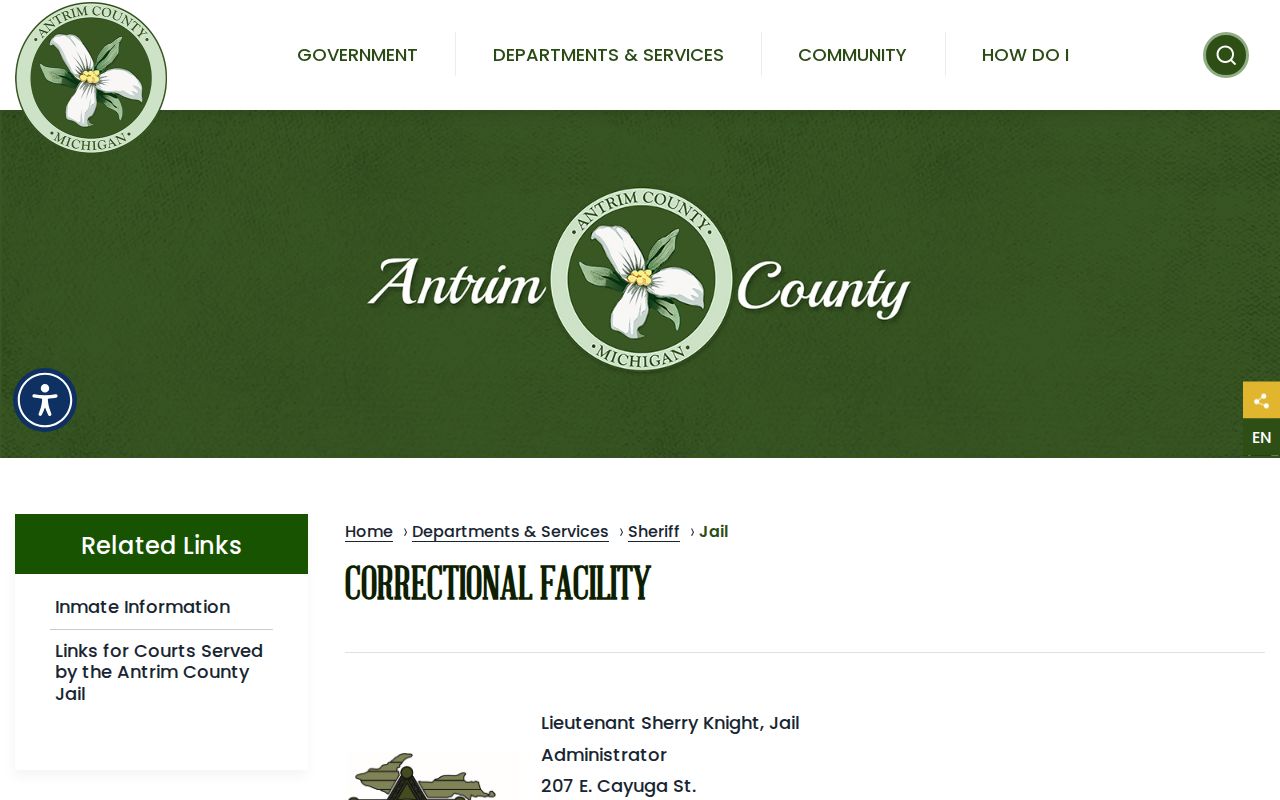
The county description supports the key distinction between an Antrim release to the community and an Antrim transfer to another jurisdiction.
Antrim Release Tracking Is Internal
The official jail page describes GUARDIAN RFID tracking for people inside the facility. That system is an internal custody-management tool. It is not a public roster, a recent-release table, or a search portal. The contrast is locally important: operational data can exist inside the jail even when the public website shows no current occupant or release archive.
Public confirmation must use a releasable sheriff response, MI-VINE when the booking participates, the court record, or a formal records request. Internal tracking should never be advertised as a service the public can query. Its existence also means a missing web record cannot be translated into “the jail has no data.” The proper question is which public record or office can confirm the custody event.
Verify Antrim Post-Release Supervision
Parole and probation answer different questions after release. Parole follows release from state prison and keeps the person under MDOC supervision. Probation is ordered by a court and may occur without any prison term. Both may appear in OTIS when MDOC supervises the case, but neither proves the time an Antrim jail booking ended.
Start with the OTIS status and Assigned Location. Search Parolees for a person physically out of prison, Probationers for MDOC-supervised felony probation, and Discharged for completed department jurisdiction. An absconder status means supervision continues despite alleged loss of contact. A future Supervision Discharge Date remains prospective.
Antrim County Parole/Probation Office
107 E. Cayuga St.
P.O. Box 386
Bellaire, MI 49615
Phone: 231-533-5136
The MDOC Region 2 directory identifies the Bellaire office. Contact it after OTIS shows an Antrim assignment when a supervision field is unclear. The office does not own the county jail release log and is not the source for a bond or jail-only time-served departure.
Note: Confirm the public OTIS status first, then contact the assigned field office about a supervision detail or possible error.
Check Antrim Release Notifications
MI-VINE is Michigan’s free custody and case-notification service. The Antrim inmate-information page links to VINELink, but no stable official participant list proves that every Antrim booking appears. Search the individual, match the agency and identifiers, and register for the offered custody events. A release or transfer alert can corroborate a change, but it cannot prove that no other hold or supervision follows.
Federal paths remain separate. The BOP Inmate Locator can show a past release date and “RELEASED” for a sentenced federal prisoner. USMS has no public name-based prisoner locator, so pretrial federal status may require the court docket or responsible office. The ICE detainee locator covers current detainees and a limited recent-release window. An ICE release means departure from civil immigration detention, not proof about an earlier Antrim booking.
The Michigan Public Sex Offender Registry is a separate limited-purpose source. It applies only to people legally required to register and is not an Antrim released-inmate list. An active non-incarcerated status may add context for a matching registrant, but it does not provide the Antrim release date or reason. Absence from the registry proves little because most released people fall outside its legal scope.
Note: A MI-VINE alert reports a custody event from a participating source; it does not resolve every later hold or supervision term.
Compare Antrim Release Search Paths
Each system proves only what its owner records. Use the custody source that matches the event and verify a positive match with more than a name.
Antrim booking: The sheriff release record supplies the county exit time and recorded disposition. MiCOURT supplies the bond, dismissal, sentence, probation, or commitment context.
State custody: OTIS supplies prison, parole, probation, assignment, absconder, and discharge status. Date Paroled is stronger than a future eligibility date for past release.
Other systems: MI-VINE reports participating custody events. BOP supplies a federal prison release date, while ICE covers its separate custody system within a limited recent-release window.
Browse Antrim Release Facilities
The Antrim County Correctional Facility is the only local detention facility identified in the research. The other pages cover the separate systems that may receive a transfer or hold a later release record. MDOC covers state prison and community supervision. BOP and USMS cover different stages of federal custody, while ICE handles civil immigration detention.
- Antrim County Correctional Facility for the local booking, release sheet, and transfer destination.
- Michigan Department of Corrections prison system for prisoner, parolee, probationer, and discharge status.
- MDOC Field Operations Administration for assigned parole or felony-probation supervision.
- BOP and U.S. Marshals custody for sentenced or pretrial federal cases.
- ICE detention system for civil immigration custody and its recent-release window.
A planned Public Safety Center may change entrances or service locations in the future, but the official source still lists the correctional facility at 207 E. Cayuga St. Verify the location before a visit rather than substituting a future project address.