
Antrim Release Dates Explained
A projected date is a forward-looking calculation. An actual release date records an event that already occurred. That distinction is vital in Antrim County because several systems use dates for different legal stages. A court may set bond or impose a jail term. The Antrim County Correctional Facility processes the court order, checks other holds, applies jail credit, and records when its custody ends. The Michigan Department of Corrections uses a separate state-prison sentence structure. Its public OTIS profile may show the earliest point when the Parole Board gains authority to consider release, but that date does not promise that the prisoner will leave.
A person awaiting trial often has no calculated release date. Bond may be posted, changed, or revoked. A charge may be dismissed. Another warrant or detainer can prevent departure even after one court authorizes release. A detainer is a request from another authority to keep custody or arrange a transfer. For a sentenced person, the judgment and valid credit supply a starting point, but the public should not calculate a firm exit date from sentence length alone.
Find an Antrim Projected Release
First identify the custodian. The Antrim County Correctional Facility holds county jail detainees and people serving local jail terms. OTIS does not cover them. The Michigan Department of Corrections OTIS search covers state prisoners, parolees, probationers, and people discharged from MDOC supervision within its published period. Federal and immigration dates come from separate systems. Mixing these sources can turn a transfer into a false claim of community release.
The Federal Bureau of Prisons locator may show a future projected federal release date, which can change after sentence-credit recalculation. A past date with location RELEASED confirms departure from BOP custody, not the end of supervised release or the absence of another hold. ICE’s locator has a limited recent-release window but does not provide an Antrim jail sentence forecast. The U.S. Marshals Service has no public name-based prisoner locator. A federal court docket or official records route is needed for federal pretrial custody.
Use a source-led sequence and preserve the name, identifier, date checked, and result. A missing county result cannot establish release because Antrim County does not publish a public current roster or projected-date feed. Likewise, an OTIS no-match says little about someone whose case never entered MDOC jurisdiction.
- Confirm whether the person is in Antrim jail, an MDOC prison, federal custody, or immigration custody.
- For Antrim jail custody, review the court judgment and ask the jail for the time computation or release record.
- For an MDOC prisoner, search OTIS by offender number or last name, then verify the profile identifiers and sentence county.
- Read the exact date label. Do not substitute an ERD, maximum date, or supervision end date for actual release.
- Recheck the record after the expected event. A past Date Paroled or completed release record is stronger than a forecast.
The broader named-person route is available through the Antrim County released-inmate search. It combines county, court, notification, and transfer records when custody history is unclear.
Note: Record a server error as unavailable, not as proof that the person has no Antrim County or MDOC record.
Antrim Release Dates in OTIS
Michigan uses precise terms. OTIS calls the state-prison eligibility field PAROLE BOARD JURISDICTION DATE, also described as the earliest release date or ERD. It is the first lawful point when the Michigan Parole Board may gain jurisdiction. It is not an appointment to leave prison. The Board may grant, deny, or defer parole, and later information or misconduct can suspend a grant. The MAXIMUM DATE reflects the maximum sentence boundary under the governing sentence rules. It also is not a promised departure time.
The retrospective field DATE PAROLED is more useful once physical release from prison has occurred. A current status of Parolee means the person is out of prison but remains under MDOC supervision. A future Supervision Discharge Date concerns the expected end of supervision, not prison release. Current Status: Discharged is the clearer public sign that MDOC jurisdiction has ended. OTIS keeps discharged profiles within three years of supervision discharge, so older cases may require MDOC records retention or FOIA.
The official OTIS date definitions show how these labels differ.
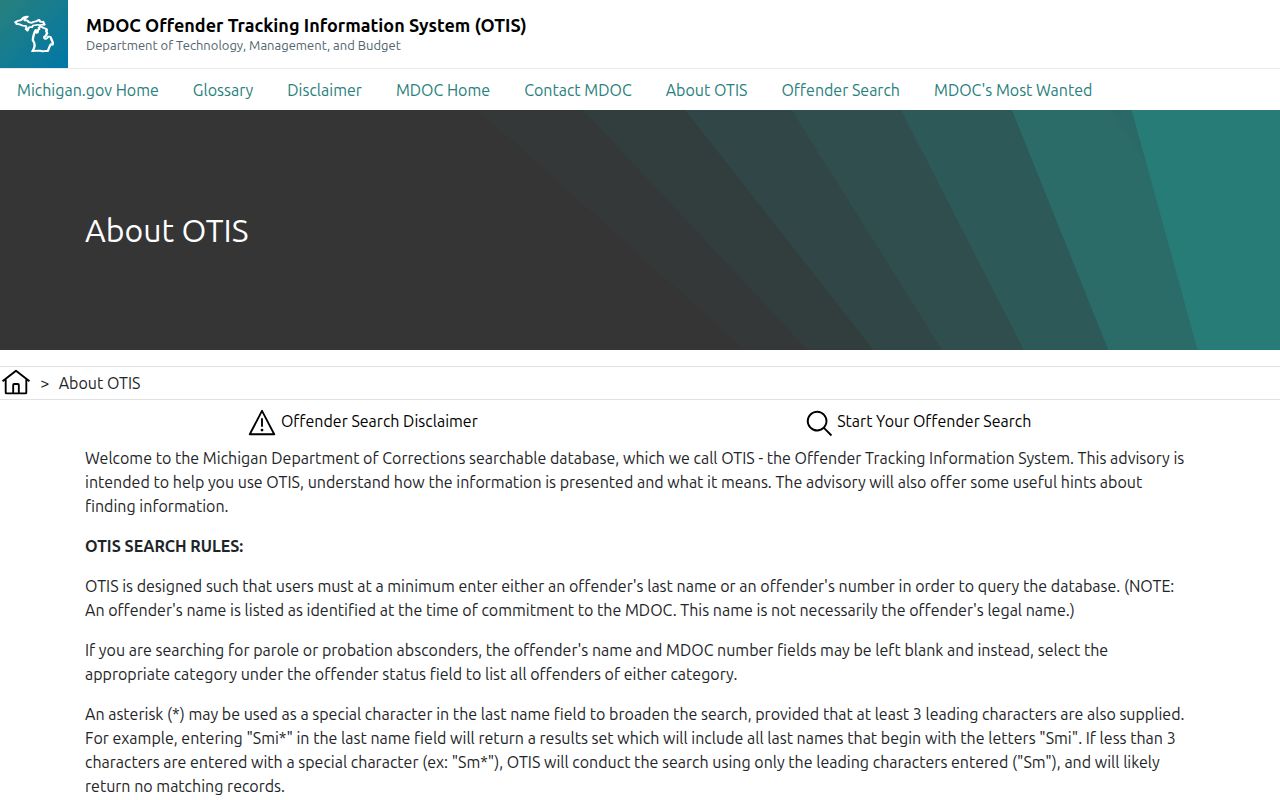
The captured definitions support careful reading of eligibility, maximum, parole, and discharge dates before making any claim about an Antrim County person.
| OTIS field | What it means | What it does not prove |
|---|---|---|
| Parole Board Jurisdiction Date / ERD | Earliest point for Board jurisdiction | A scheduled prison exit |
| Maximum Date | Maximum sentence boundary under applicable rules | A fixed pickup time or certain release |
| Date Paroled | Past date the person acquired parole status | Completion of supervision |
| Supervision Discharge Date | Planned or completed supervision end, read with status | Physical prison release by itself |
| Current Status: Discharged | MDOC jurisdiction has ended | The precise Antrim jail release event |
Michigan Sentencing Changes Antrim Dates
Michigan Truth in Sentencing is not an 85 percent rule. For covered state-prison cases, the prisoner serves 100 percent of the minimum term in prison before parole consideration. MDOC states that the rule applies to listed assaultive offenses committed on or after December 15, 1998, and other covered offenses committed on or after December 15, 2000. Good time or disciplinary credits do not shorten that minimum. Eligibility at the end of the minimum still does not compel a parole grant.
For these cases, disciplinary time is linked to Class I misconduct and informs the parole process. It is not a simple public calculator that adds a fixed number of days. MCL 800.34 defines disciplinary time, while MCL 800.35 governs MDOC rules for misconduct amounts. MCL 791.234 controls Parole Board jurisdiction, and MCL 791.233 keeps eligibility distinct from an actual grant. The offense date and sentence type must be checked before applying any rule.
The MDOC Truth in Sentencing explanation documents the full-minimum requirement.
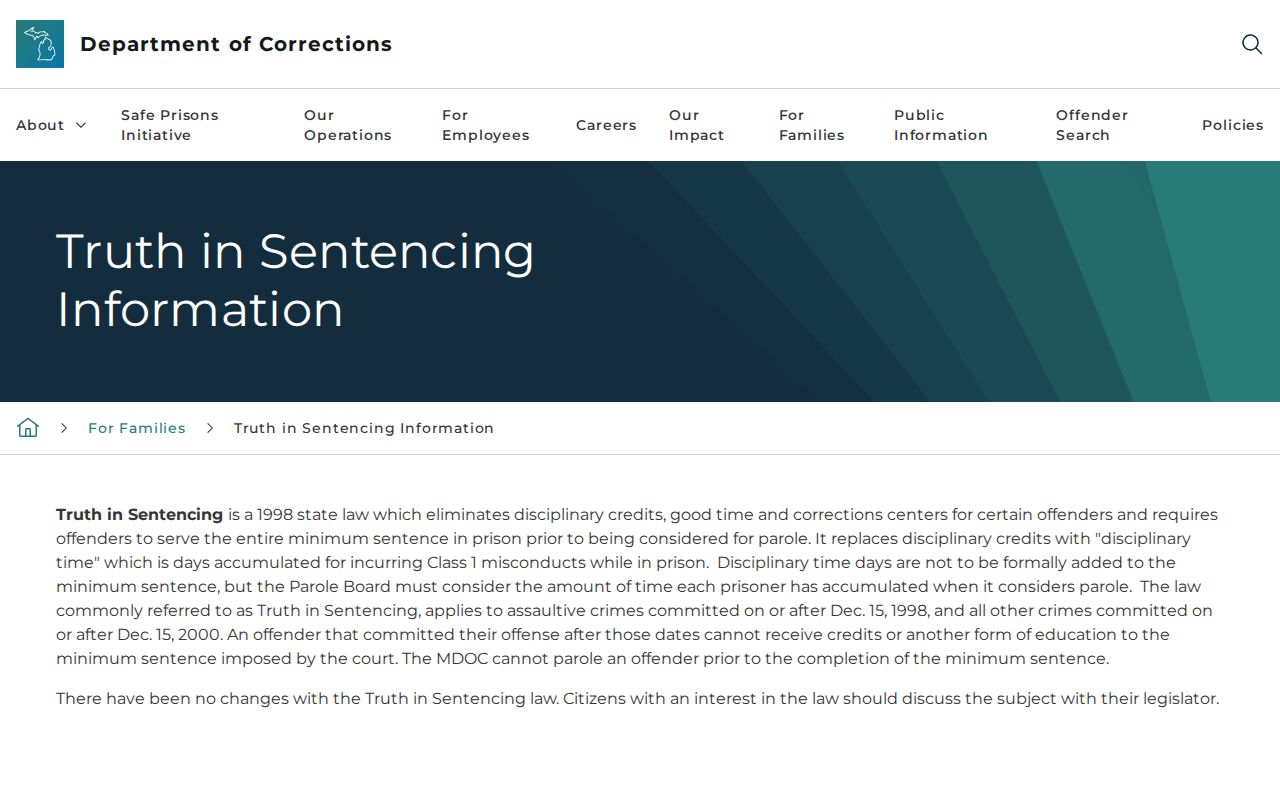
This state guidance is the right baseline for a covered MDOC sentence connected to Antrim County, while the judgment and OTIS profile control the individual date fields.
Legacy cases may retain good-time or disciplinary-credit treatment. MDOC describes disciplinary credits in general as five days per month, with two more days for exceptionally good behavior, subject to loss and annual limits. Those terms must not be applied to a modern truth-in-sentencing case. MCL 800.33 and the applicable offense date determine whether a legacy rule belongs in the calculation.
Antrim Jail Release-Date Rules
A county jail date follows a different path. MCL 51.282 and MCL 51.283 authorize a sheriff-administered good-behavior framework, including posted rules and the possible forfeiture or restoration of an allowance. The research found no current Antrim County posted allowance table and no official public calculator. That gap rules out a trustworthy do-it-yourself date. The court judgment, jail credit, sheriff rules, other holds, and release processing all matter.
Ask the jail for the existing time computation and release record. If a durable copy is needed, the Antrim Sheriff FOIA channel accepts a focused request for the judgment or release authorization held in the jail file, jail credit, calculated term, release date and time, release code, and receiving agency if transferred. Antrim staff can also clarify whether the person left county custody for the community or went to another custodian. Removal from the jail is not always release.
Pretrial cases require the court path. MiCOURT may show a bond order, dismissal, sentence, probation, or commitment, but an order does not record the minute the person walked out. The jail must receive and process it, check other holds, and complete departure steps. Use the court entry and the jail release record together.
Note: Antrim County’s official sources had no projected-date feed when reviewed July 23, 2026; confirm calculations with the jail records holder.
Why Antrim Release Dates Move
Future dates can change for lawful and administrative reasons. A corrected judgment may alter credit. Consecutive state sentences add minimum terms for parole jurisdiction and maximum terms for discharge under MCL 791.234. A Board decision can be deferred, denied, granted, or suspended. A transfer or detainer can end one agency’s custody without placing the person in the community.
| Factor | Possible effect | Best confirmation |
|---|---|---|
| Corrected judgment or jail credit | Recalculates the sentence start or remaining term | Sentencing court and jail or MDOC record |
| Consecutive sentences | Adds state minimum and maximum terms | Judgment blocks and OTIS sentence detail |
| Parole decision | Grant, denial, or deferral changes the expected path | Later OTIS status and Date Paroled |
| Misconduct | May affect legacy credit or Board review | MDOC sentence and conduct records |
| Detainer or hold | May cause continued custody or transfer | Releasing and receiving agencies |
| Resentencing or appeal | Can amend the controlling judgment | Official court file |
A source date belongs beside any forecast. If a result later changes, keep both the old capture and the corrected source rather than assuming one unexplained date controls.
Does Antrim Use the 85% Rule?
No single percentage applies to all Antrim County sentences. Covered Michigan Truth in Sentencing cases require the whole minimum state-prison term before parole consideration, not about 85 percent. Older MDOC cases may involve legacy credits. Antrim County jail sentences use county-jail authority and local sheriff rules instead of the OTIS state-prison framework. The offense date, custodian, judgment, and statutory scheme decide which calculation applies.
This local split is why a generic online sentence calculator can mislead. It may confuse parole jurisdiction with release, apply state credits to a county term, or ignore consecutive sentences and jail credit. For an Antrim jail term, request the jail computation. For an MDOC term, read OTIS labels and the judgment, then seek a sentence review or records response if the numbers conflict.
- Eligibility
- The first point when release may lawfully be considered.
- Parole
- Physical release from prison while MDOC supervision continues.
- Discharge
- Completion of MDOC sentence or supervision jurisdiction.
- Detainer
- A request that custody continue or transfer to another authority.
Confirm an Antrim Release Date
Confirmation should match the event. For a county jail departure, obtain the Antrim release timestamp and release or transfer code. For a state prisoner, recheck OTIS for a past Date Paroled and Parolee status. Contact the assigned MDOC field office when an assigned location or supervision field is unclear. A future supervision discharge date should remain labeled as prospective until current status confirms completion.
MI-VINE may send a custody-change notice for a participating booking, but Antrim participation for a specific booking should be checked live. The VINE Inmate Check explains the named-person and alert route. A notification can corroborate a departure; it does not rule out a transfer, detainer, parole term, or another agency’s custody. The best final record is the one owned by the agency responsible for the event.