
Federal Custody Release Paths
No Federal Bureau of Prisons institution or U.S. Marshals detention facility was identified as physically operating in Antrim County. These systems become relevant only when the Antrim jail record, a court file, or another official source documents a federal transfer or federal sentence. The phrase “federal release” must therefore be tied to the agency. A person may leave Antrim County custody for the U.S. Marshals Service, later enter BOP custody after sentencing, or return to another custodian. None of those events is proved by disappearance from Antrim’s jail information.
The BOP holds sentenced federal prisoners. A person leaving BOP may return to the community, move to another authority, or remain subject to federal supervised release. Supervised release is a court-ordered period after imprisonment, not BOP prison custody. The U.S. Marshals Service handles federal pretrial, remand, and transport custody. Its prisoner-tracking system is not open to public name searches. A federal court docket, the responsible office, or a records request must fill that gap.
| Federal path | Public source | What the result can prove |
|---|---|---|
| Sentenced BOP prisoner | BOP Inmate Locator | Past release date and departure from BOP custody |
| Future BOP release | BOP Inmate Locator | A projected date that may change |
| USMS pretrial or transport custody | Federal court file or official contact | Case disposition, remand, release, or custody handoff |
| Antrim-to-federal transfer | Antrim release or transfer record | When county custody ended and the receiving agency |
Confirm a BOP Inmate Release
The Federal Bureau of Prisons Inmate Locator covers federal prisoners from 1982 to the present. Search by BOP Register Number when it is known. The locator also accepts DCDC, FBI, or INS numbers. A name search can use first, middle, and last name with age, race, and sex refinements. Those refinements help separate similar names, but the register number is the stronger match.
- Confirm that the person was sentenced into BOP custody, not held only by the U.S. Marshals Service.
- Search the federal identifier first. If unavailable, enter the full name and use supported refinements.
- Compare the result’s name, register number, age, race, and sex with the known record.
- Read the Release Date and Location columns together.
- Treat a future date as projected. Treat a past date with no facility or location RELEASED as departure from BOP custody.
- Check the federal court file or another agency when supervised release, a detainer, or a custody transfer remains possible.
The official locator shows the public search fields and result structure used for an Antrim-connected federal release inquiry.
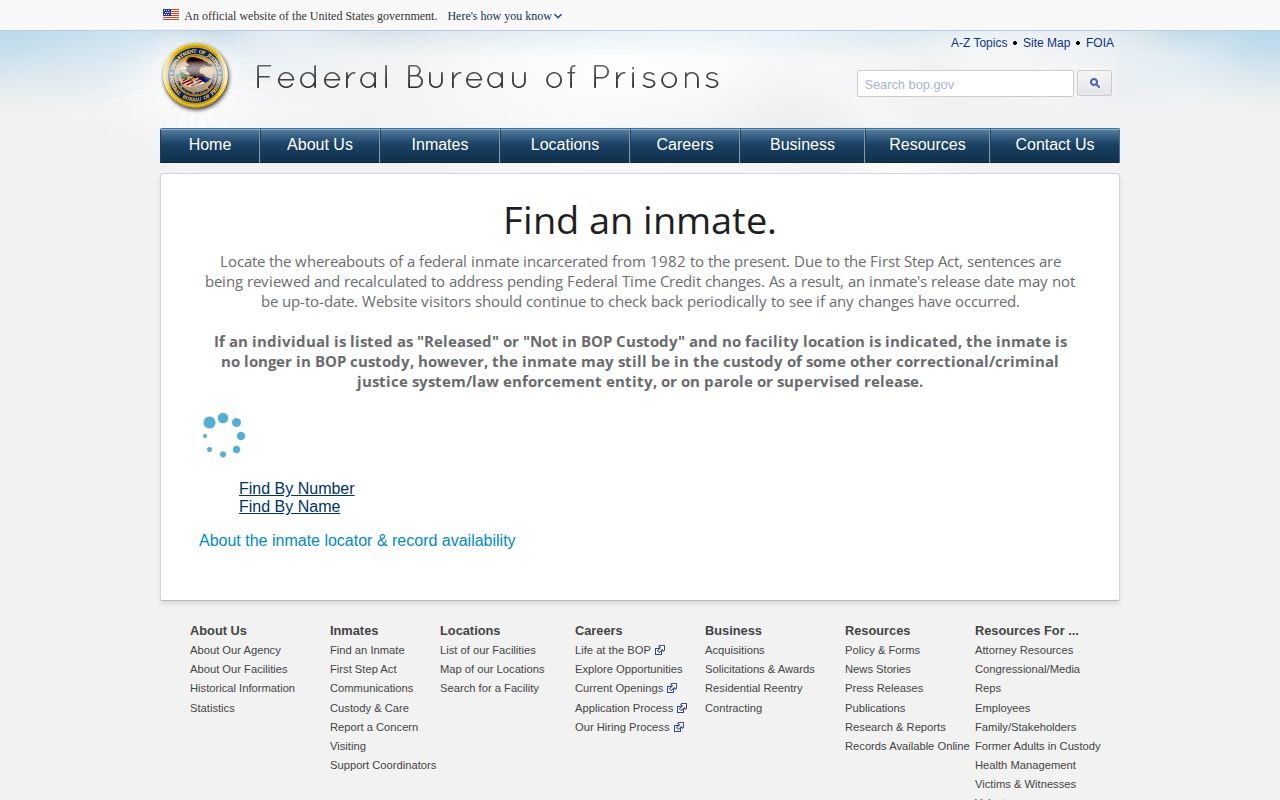
The image demonstrates why an identifier and the Release Date and Location fields should be read together instead of relying on a same-name match.
The wider Antrim County released-inmate search helps determine whether federal custody is actually the correct route when the last custodian is uncertain.
Read BOP Release Results
A past release date paired with no current facility means the person left BOP custody on that date. Location RELEASED has the same limited meaning. A result stating that a person is not in BOP custody also must be read narrowly. It does not show that supervised release ended. It does not rule out U.S. Marshals custody, a state or county hold, immigration custody, or another institution outside BOP.
A future date is a projection. BOP says locator data is extracted and updated daily, and sentence-credit recalculation can change a displayed date. UNKNOWN means the term of confinement has not been determined. It is not a hidden release date and should not be estimated from the offense or sentence alone. Preserve the search date and exact displayed label when a future result matters.
The official BOP locator record definitions explain how its release labels should be interpreted.
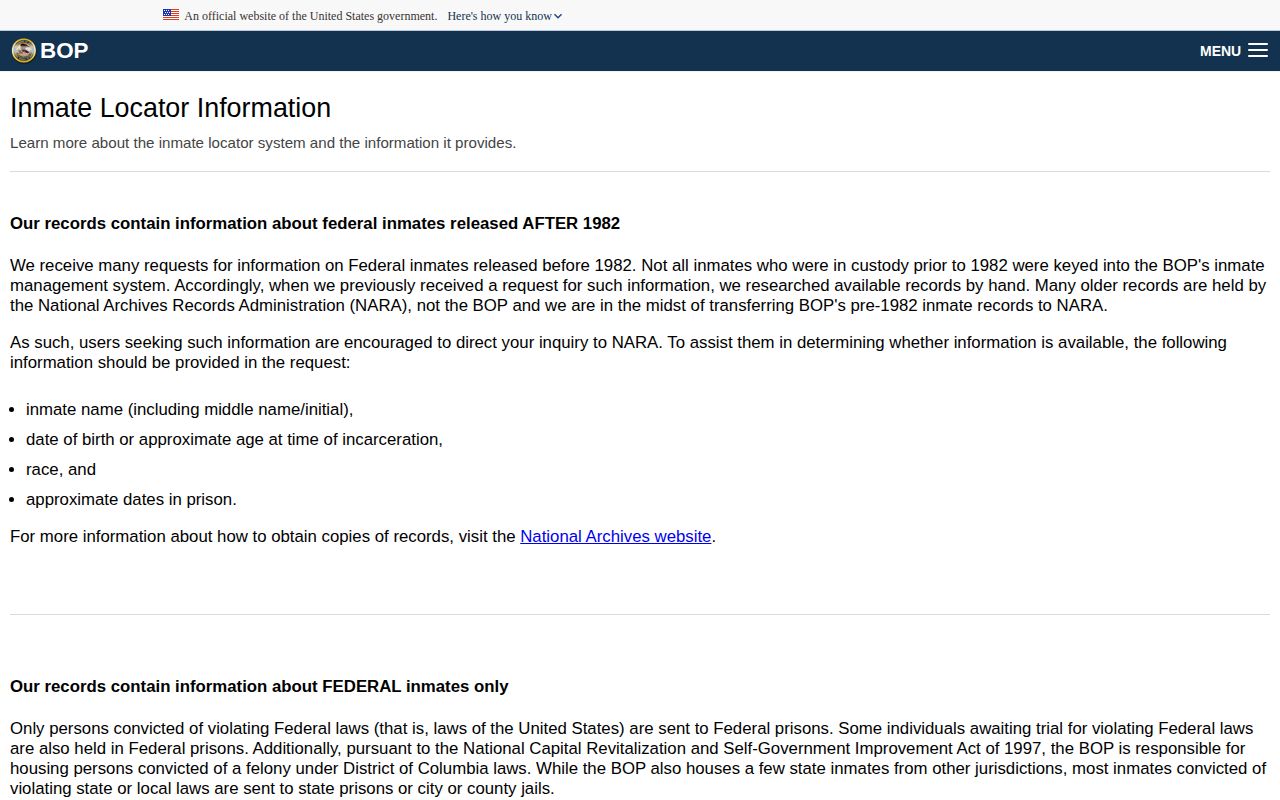
The definitions confirm only the BOP custody event. They do not convert a federal prison result into proof of unrestricted community status.
BOP Records for Past Releases
The public locator is the first source for a basic BOP release date, but it does not provide every document behind the result. Details can require a BOP records request and identity certification. Request an existing record, identify the prisoner by full name and register number, narrow the relevant date range, and state the specific document or field needed. A focused request is more useful than asking the agency to reconstruct an entire life history.
Federal Bureau of Prisons Release Records
Public status: BOP Inmate Locator
Search coverage: 1982 to present
Older prisoner history: National Archives and Records Administration
Detailed records: BOP records request with required identity certification
For a release inquiry, useful existing records may include the release-date record, sentence-computation material, facility history, or custody-transfer record, subject to federal disclosure rules. The research did not establish a local BOP records counter in Antrim County. Do not send a federal prison request to the Antrim sheriff merely because the original arrest or court trail began locally.
Pre-1982 federal prisoner history generally requires the National Archives and Records Administration. A current locator no-result may therefore reflect the time boundary rather than proof that no federal custody occurred. Keep “outside locator coverage,” “no match,” “search unavailable,” and “released” as separate findings.
USMS Release and Transfer Records
The U.S. Marshals Service follows federal detainees from arrest or remand through commitment, release, or return to another custodian. Its Prisoner Tracking System contains that movement history, but public access is restricted to authorized users. There is no public USMS name-based prisoner locator. Searching BOP for a person who has not yet been sentenced can therefore return nothing even while federal pretrial custody continues.
The USMS prisoner-tracking description documents the system’s role. Public confirmation normally comes from the federal court case, the responsible office, or a formal records request. After federal sentencing, check BOP. Before sentencing, read the federal docket for release, detention, remand, plea, sentencing, or transfer entries, then verify the custodian named by that record.
A court release order is legal authority, not necessarily the exact time of physical departure. Staff still process the order and check other holds. Likewise, a USMS transfer record can prove departure from one location without showing community release. Ask which agency received the person and continue with that source.
Note: A BOP no-result is expected for many USMS pretrial detainees and must not be recorded as proof of federal release.
Antrim Federal Custody Handoffs
Antrim County’s local record establishes the first side of a federal handoff. The sheriff record can show when county custody ended, the release or transfer code, and the receiving agency if maintained. Call the Antrim County Correctional Facility at 231-533-8627 and ask whether the booking ended in community release or transfer. For written proof, request the booking and release record through the sheriff FOIA channel.
The federal source establishes the other side. If the person received a federal prison sentence, BOP can show the later location and release date. If the case remained pretrial or in transport status, use the federal court file or USMS route. A delay between Antrim and federal updates can create a short information gap. That gap is not evidence of an undocumented release.
Federal and immigration custody also should not be merged. An immigration detainer or later ICE custody belongs to the ICE detention release record, while a federal criminal sentence belongs to BOP. The agencies can appear in the same custody history, but each record proves a different event.
BOP Release-Date Limits
A BOP future date may change after sentence-credit recalculation. A past date is stronger because it records a completed BOP event, but it still has a narrow scope. Supervised release is administered under the federal court sentence after imprisonment. Another agency may also assume custody. The locator cannot resolve those questions by itself.
| BOP display | Safe conclusion | Required follow-up |
|---|---|---|
| Future Release Date | Projected BOP date | Recheck after the expected event |
| Past date and RELEASED | No longer in BOP custody | Check court supervision and other custodians |
| UNKNOWN | Term not determined | Use official sentence and computation records |
| No match | No confirmed locator result | Verify spelling, identifier, coverage, and USMS status |
Do not translate any of these entries into a claim about Antrim jail release unless the county record documents the connection. The BOP entry answers only the federal prison portion of the custody trail.
Federal Release Record Checklist
A sound federal record keeps the person, agency, event, and date together. Record the exact name, federal identifier, search date, result location, and release-date label. Compare the federal case and known Antrim record before accepting a match. If the source fails to load, mark it unavailable. If two records share a name but not an identifier, mark the result ambiguous.
- BOP Register Number
- The strongest public locator key for a sentenced federal prisoner.
- Release Date
- A projected or past BOP date that must be read with Location.
- Supervised release
- A federal court status after prison, separate from BOP custody.
- Remand
- A court order placing or keeping a person in custody.
- Custody handoff
- A documented transfer from one agency to another, not community release.
The final confirmation should state only what the source proves: released from BOP, released in a federal case, transferred by USMS, or released from Antrim custody. These are not interchangeable claims.